Lead generation in digital marketing, 10 ways to generate more leads
Learn how to generate more leads by choosing marketing strategies that fit your business, budget, and sales cycle.
Lead generation
Home services
The Leapyn team
November 18, 2026
20 min read
In this post
toc
Most businesses want more leads. That part isn't complicated. The complicated part is that most advice on lead generation in digital marketing sounds the same no matter who wrote it, and almost none of it accounts for how your business works, what you can afford to spend, or how long you can wait before results need to show up.
According to HubSpot's 2026 State of Marketing Report, lead quality and marketing qualified leads are now the number one metric that matters to marketers, followed closely by lead to customer conversion rate. And yet the gap between "we need more leads" and "we're consistently getting the right ones" stays stubbornly wide for most businesses, year after year.
Plenty of businesses work hard at lead generation and still come up short, because the tactics they copied were never built for their situation, so they fill a pipeline with people who were never going to buy.
This guide gives you the full list of ways to generate more leads, a channel by channel look at where those leads come from, and the thinking you need to pick the right mix for your business and know whether it's working.
What is lead generation in digital marketing?
Lead generation in digital marketing is the work of turning online attention into contacts your sales team can talk to. Someone finds you through search, an ad, a post or an email, takes an offer worth trading their details for, and lands in your CRM with a record of how they got there.
That record is what separates digital marketing lead generation from a trade show booth or a referral, because every step leaves data you can use to decide where the next dollar goes.
A lead is anyone who has raised a hand, whether that's a form fill, a signup or a reply to outreach. Volume is the number everyone reports, and it's one of the most misleading numbers in marketing. What matters is more of the right leads, the people who fit what you sell and have a realistic chance of buying.
Research compiled by Email Vendor Selection found that leads take 64.5 days on average to become customers, and the industries with the weakest lead conversion rates barely clear 1.5 percent. At margins that slim, chasing raw volume is an expensive way to fill your CRM with names that never go anywhere.
What makes digital marketing lead generation different
Three things set it apart from offline lead generation.
You can see the whole path. With tracking set up properly, you know which page, ad or email a lead came from and which of those leads became customers. That lets you cut spend on the campaigns that bring form fills nobody buys from.
You can test in weeks instead of quarters. Two versions of a landing page or an ad can run side by side, so you find out what converts before you commit the full budget.
You can aim at the buyer. Search reaches people by what they typed, LinkedIn reaches them by job title, and retargeting reaches the people who already visited your pricing page. A billboard can't make that choice for you.
The channels in this guide each do one job well. The leads come when they're connected, so a search visitor sees a retargeting ad a week later, downloads a guide, and gets an email sequence that ends with a booked call.
What are the best ways to generate more leads?
Every one of these works for somebody, and none of them works for everybody. The rest of this guide helps you choose, but this is the full menu in one place.
Build a website that converts. Put a clear call to action where people are most engaged on every page, build landing pages that convert for specific offers and audiences, and keep forms short enough that they don't feel like a tax return.
Publish content that answers buyer questions. Write about the specific problems your ideal customers already search for, and match the format to their stage, from guides for early research to case studies for buyers comparing options.
Use SEO to show up when people search. Structure pages with clear headings and direct answers so search engines and AI summaries can quote them, and keep your Google Business Profile accurate if you sell locally.
Run paid ads with discipline. Target tightly, send each ad to a landing page that matches its promise, and retarget the people who visited but didn't convert.
Nurture with email. Segment your list by interest and buying stage, then send a welcome series that teaches, follows with proof, and makes the offer once engagement says they're ready.
Treat LinkedIn like a sales floor. If you sell to businesses, publish expertise rather than company news, comment where your buyers talk, and test Lead Gen Forms on paid campaigns.
Build referral and partner programs. Ask happy customers for introductions on a schedule, reward them for it, and partner with businesses that meet your buyer before you do, like an HVAC company teaming up with a local real estate agency.
Host webinars and live sessions. Office hours and panels with live questions turn registrations into leads who have told you exactly which topic they care about.
Score leads and automate follow up. Give points for buying signals like repeat visits to your pricing page, and let CRM workflows alert sales when a lead crosses the line.
Measure what closes. Track where every lead came from and which ones become customers, then cut the campaigns that don't pay their way, even the ones you liked.
Why generic lead generation advice fails
The standard playbook tells you to do some mix of content, social, email, paid ads and SEO. That advice isn't wrong, but it's so vague it can't tell you where to put your next hour or your next dollar.
Snov.io's lead generation statistics put the average cost per lead across paid and organic channels at $391.80, from about $91 in ecommerce to nearly $982 in higher education. With a spread that wide, "run some ads and do some content" is a coin flip with your budget.
Data compiled by EmailTooltester shows that 90 percent of marketers use content marketing for lead generation, while 45 percent of content marketers say attracting quality leads is one of their biggest challenges. So the gap is in choosing which tactics fit, and almost nobody helps with that part.
One size does not fit all businesses
A B2B software company selling six figure contracts, a local plumber and an ecommerce brand share almost nothing except that they all want more customers.
The software company has to reach specific decision makers and win over a buying committee across months. 6sense's 2025 B2B Buyer Experience Report found that buying groups fill four of their five shortlist spots on day one, so the vendors they already know get most of the seats. The plumber needs to show up when someone has a burst pipe at 10pm on a Tuesday, and the ecommerce brand needs to convert visitors before they close the tab. Expecting one playbook to serve all three is why so much marketing advice feels useless.
Budget and timeline realities nobody talks about
Lead generation takes longer and costs more than most advice admits, because "results take months" doesn't make a compelling headline. The same 6sense study puts the average B2B buying cycle at 10.1 months in 2025, down from 11.3 months the year before, which makes a 30 day verdict on your lead generation close to meaningless.
Cost swings by channel too. EmailTooltester's cost per lead figures put SEO and online retargeting at around $31 per lead and events and trade shows at about $811. The cheaper channels usually take longer to pay off, so a business that needs leads next month has very different options from one that can build for six months.
How to choose the right lead generation tactics
Three factors decide which tactics fit your situation, and they matter more than whatever sounds good in the latest marketing article you read.
Match your tactics to your sales cycle
A long sales cycle with several decision makers needs tactics that build relationships over time. Content, email nurturing and account based marketing keep you in front of prospects through months of evaluation without feeling pushy.
A short, transactional cycle needs tactics that catch people at the moment they're ready to buy. Search ads, local SEO for small businesses and direct response offers reach people with intent right now. Mismatching the two is one of the fastest ways to waste a lead generation budget.
Match your tactics to your budget
Paid advertising needs spend from day one. Content takes time and skill before it attracts anyone, SEO takes months of steady work before organic traffic shows up, and referrals, networking and organic social cost little money but a lot of your team's time.
Be candid about what you can sustain. A $500 ad test won't give you meaningful data in a week, and a content program abandoned after two months because "it's not working yet" wastes the investment before it ever reaches the payoff.
Match your tactics to your team's capacity
Paid ads need someone who can structure campaigns, write the copy and manage bids without burning the budget. Content needs a writer your buyers want to read, and SEO needs technical knowledge most owners don't have time to learn.
If you can't hire or outsource those skills well, the tactic will underperform, because a decent strategy run consistently beats a brilliant one run badly.
Lead generation strategies by investment level
This is how the options sort by what they ask of your business.
Investment level
Tactics
Best for
Timeline to results
Low cost, high effort
Referrals, networking, organic social, email outreach to existing contacts
Businesses with existing customers or a network to draw on
1 to 3 months
Medium investment
Content marketing, email marketing, basic SEO, webinars
Businesses with some marketing budget and team capacity
3 to 6 months
Higher budget
Paid advertising, advanced SEO, account based marketing, events
Businesses ready to invest for scale and speed
1 to 6 months depending on channel
Low cost lead generation tactics that work
Referral programs are one of the most efficient sources of leads for businesses with happy customers, because a referred prospect arrives with credibility no ad can buy. Ask on a schedule, since even your biggest fans won't think to recommend you unless you give them a reason.
Networking and relationship building matter most in B2B, where buyers pick favorites early. In the same 6sense research, 94 percent of buyers had ranked the vendors on their shortlist before contacting any of them, so being known before the buying process starts counts for more than most businesses realize.
Case studies and social proof lift conversion on the leads you already get. DesignRush's lead generation statistics report that brands using content as a lead source see up to 6x higher conversion rates than those that don't, and a case study from a business like the prospect's removes one of the biggest doubts in the whole sale.
Higher budget approaches
Account based marketing suits B2B companies where one new customer is worth significant revenue. It aims coordinated outreach and ads at a named list of target companies, and it tends to bring larger deals when marketing and sales run it together. Our explainer on what account based marketing is covers how to pick the list.
Events and sponsorships are the priciest channel at around $811 per lead in EmailTooltester's figures, but they often bring better conversations than screens do. Our guide to webinars and events that fill the pipeline shows how the follow up week decides whether a booth pays for itself.
Content, email, SEO, paid ads, social and webinars can sit in any of the three tiers depending on how hard you push them, so each one gets its own section below.
Not sure which lead generation approach fits your business? Send us your numbers. We'll show you which channels deserve the budget and which ones are just burning it. Get a second opinion on your lead generation and we'll look at your situation together.
Trade You.
Your email for great content delivered to your inbox. Regularly. Unless we forget. Or get busy. But we'll try.
Thank you! Your submission has been received!
Oops! Something went wrong while submitting the form.
How do you generate leads with digital marketing?
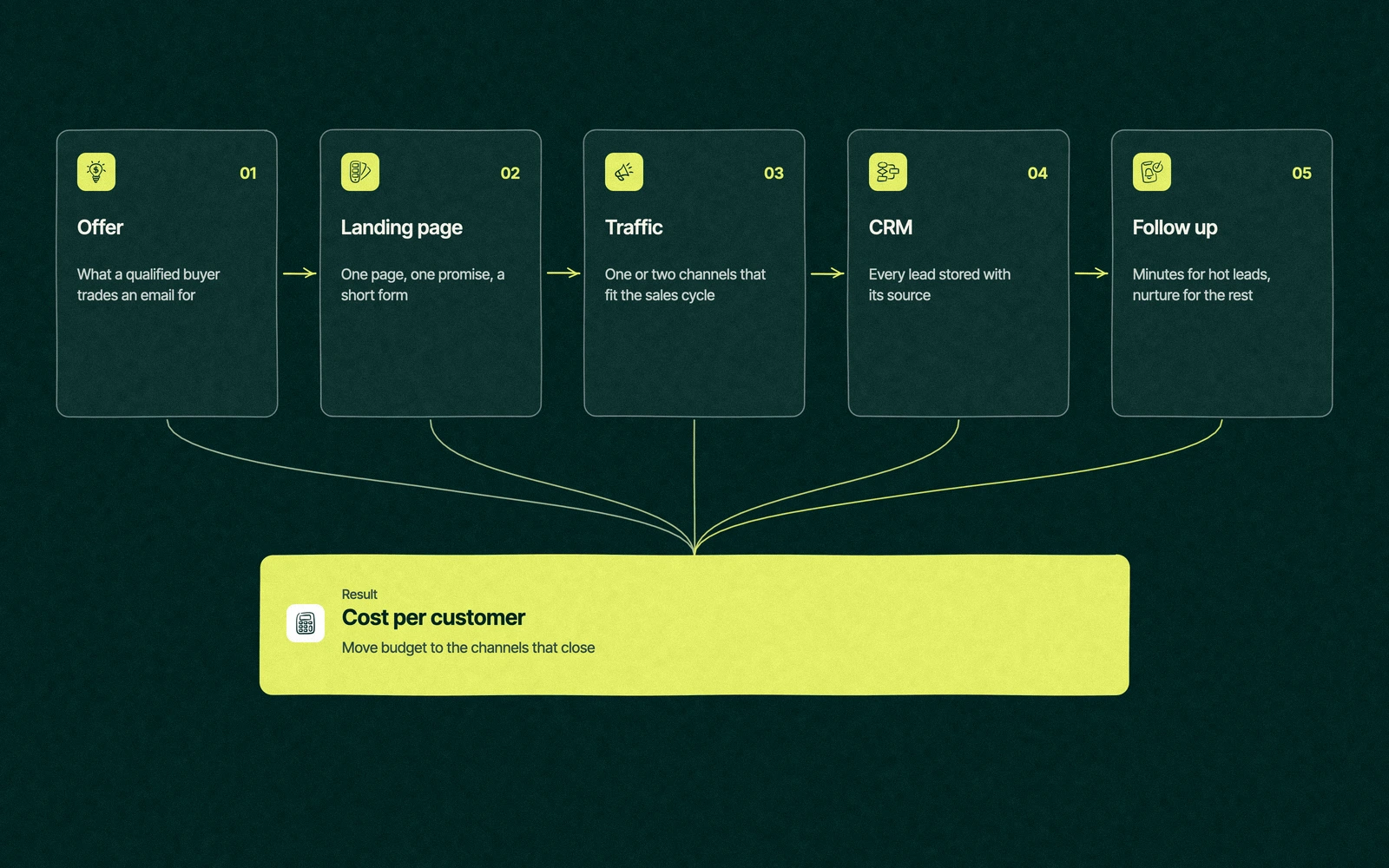
When digital marketing lead generation stalls, one of these steps is usually missing. Work through them in order and each one makes the next easier.
Start with the offer. Decide what a qualified buyer would trade their email address for. For a B2B service that might be a free audit, a pricing calculator or a strategy session. For a local business it's usually a quote or a booked appointment.
Build one page for that offer. Give it a headline that repeats the promise, a short form and proof from customers like the visitor. Our guide to choosing a web design agency covers what a page built to convert needs.
Pick one or two traffic channels to start. Short cycles favor Google Ads management and local SEO, and long B2B cycles favor content, LinkedIn and email.
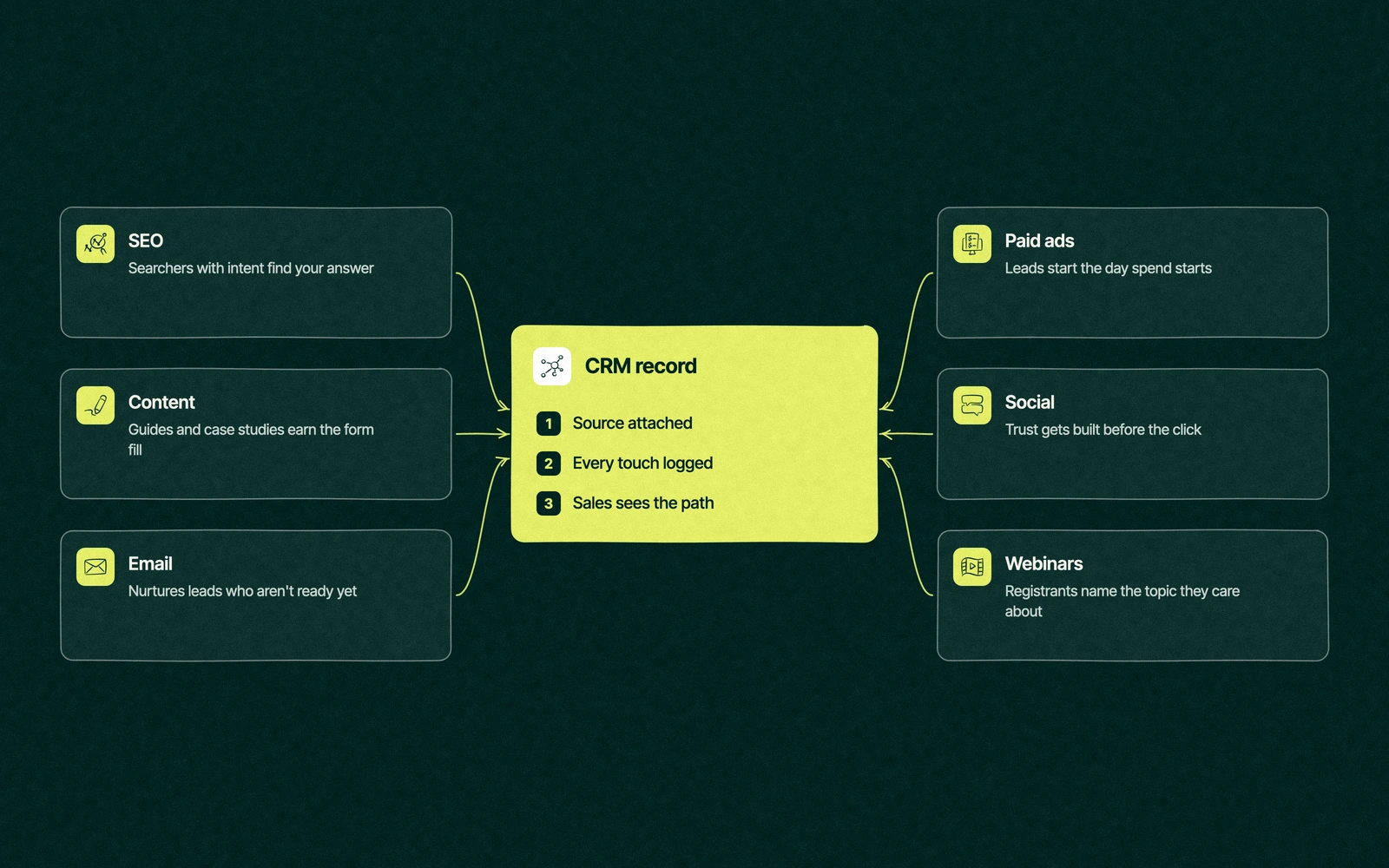
Send every lead into a CRM with its source attached. Without the source, you can't tell which channel earned the customer. A properly set up HubSpot implementation service records it automatically.
Follow up fast, then nurture the rest. Respond to hot leads within minutes, and put everyone else on an email track that matches the offer they took. The B2B lead nurturing guide covers the sequences.
Measure cost per customer, not cost per lead. Review it monthly and move budget toward the channels that close.
Which digital marketing strategies bring qualified leads?
More leads only help if sales wants to call them. These digital marketing strategies for lead generation filter for fit before a lead ever reaches your team.
Target searches with buying intent. Phrases like "agency for", "pricing" and "vs" bring people comparing options, while "what is" searches bring people still learning.
Tie every content offer to a business problem. A checklist for fixing a leaky pipeline attracts the person who owns the pipeline. A generic ebook attracts collectors.
Add one qualifying question to your forms. Company size, budget range or timeline gives sales a reason to call the right people first, and it costs you very few submissions.
Retarget by page visited. Someone who read your pricing page should see a different ad from someone who read a blog post.
Score leads on behavior. Repeat visits, pricing page views and webinar attendance tell you more than a job title alone.
If you sell software, our guide to SaaS lead generation applies these filters to trial and demo funnels, and the explainer on what demand generation is covers the work that makes buyers ready before they ever fill in a form.
How a digital marketing company can generate leads for itself
Agencies have one extra hurdle, because prospects assume every agency can market. The ones that keep a full pipeline publish case studies with numbers and pick a narrow audience, so a page built for "marketing agency for HR tech companies" beats one built for "marketing agency" when that buyer is searching.
Where the leads come from, channel by channel
Every channel below works, and every one of them struggles when it runs alone. Read each for what it does best, then use the table at the end of this section to pick your mix.
SEO, the slow channel that keeps paying
Searchers already have intent. They typed their problem into Google and your business showed up with an answer, which is why SEO and AEO services earn a place in almost every plan. EmailTooltester's data puts SEO at around $31 per lead, and organic traffic compounds, so the work keeps paying long after it's done.
The pages that bring leads target commercial and comparison searches, not only definitions, and every ranking page needs a next step, whether that's an offer, a form or a link to the matching service. A page without one is a library, and libraries don't send invoices.
More answers now appear right on the results page, so our zero click marketing strategy guide covers how to stay visible to searchers who never click.
Content that earns the form fill
DesignRush's research found that brands with active blogs generate 68 percent more leads than those without one, and gated guides can convert up to 41 percent more visitors than similar ungated content. Email Vendor Selection's data shows that 87 percent of B2B marketers have used content marketing to generate leads.
The catch nobody mentions in the "content is king" articles is that content good enough to convert takes skill, time and consistency. Publishing mediocre blog posts twice a month and calling it a content strategy is like joining a gym, sitting in the parking lot twice a month, and wondering why you're not in better shape.
Match the format to the reader's stage, from blog posts for early research to case studies and calculators for buyers weighing options. Our guide to B2B content marketing strategy covers how to plan the mix.
Email, the quiet earner
Email works for any business with a list or a credible way to build one. DesignRush's email figures put the average return at $36 for every $1 spent, and HubSpot's marketing statistics rank email as the second most used channel among marketers.
Segment from the very first form, so the person who downloaded an SEO checklist and the one who registered for a paid ads webinar each get their own track. A simple sequence delivers the resource, teaches, then makes the offer once you've earned it. Our guide to B2B lead nurturing strategies goes deeper on sequencing, the post on B2B email marketing strategy covers list building, and our email automation team builds the flows.
First Page Sage's B2B conversion rate report puts website conversion rates between 1.1 percent for B2B SaaS and 7.4 percent for legal services. At the low end, 100 paid visitors bring about one lead, so the math only works when customer lifetime value comfortably covers what you pay to win each customer.
Running ads to your homepage is like inviting someone to dinner and making them find the restaurant themselves. Save part of the budget for retargeting, judge campaigns on cost per qualified lead and cost per customer, and read our post on how long Google Ads take to work before you judge the first month.
Social, where trust gets built before the click
Organic social works when you're helpful and consistent. HubSpot's 2026 data shows that 42 percent of marketers used LinkedIn in 2025, up 11 percent from the year before, and the same page cites Sprout Social research that 89 percent of B2B marketers use LinkedIn for lead generation.
The accounts that generate leads behave like the best person at a conference. They comment on their buyers' posts, share lessons from the campaign that went sideways, and answer questions without pitching in the same breath. If you're weighing paid reach on the platform, our take on whether LinkedIn ads are effective covers when the cost makes sense, and our LinkedIn ads management team runs those campaigns.
Webinars, expertise with a signup form
Someone who registers for a session on one specific topic has told you what they care about and handed over their contact details in the same step. Pick topics that attract buyers, because a walkthrough of how a SaaS company rebuilt its pipeline draws people who hire help, while open rate tips draw collectors.
The follow up is where webinars convert. Send the recording to every registrant within 24 hours, including the ones who didn't show, tailor outreach to how engaged each person was, and cut the session into clips, posts and emails that feed your other channels for weeks.
How the six channels compare
This table puts the six channels of digital marketing lead generation side by side on speed, cost and fit, using the sources cited in this guide.
Channel
How fast it works
Cost or return signal
Best for
What to measure
SEO
Slow to start, then it compounds
Around $31 per lead (EmailTooltester)
Buyers who search for your service or their problem
Organic leads by page and how many close
Content
Builds with every piece you publish
Active blogs bring 68 percent more leads (DesignRush)
Long sales cycles where trust has to be earned
Leads from gated pieces and deals content touched
Email
Fast with an existing list, slow to build one
$36 back for every $1 spent (DesignRush)
Leads who aren't ready to buy yet
Replies, meetings booked and nurtured deal value
Paid ads
Leads start when spend starts
B2B sites convert 1.1 to 7.4 percent of visitors, by industry (First Page Sage)
Short sales cycles and buyers searching right now
Cost per qualified lead and cost per customer
Social
Weeks to months for organic reach
89 percent of B2B marketers use LinkedIn for leads (Sprout Social, cited by HubSpot)
B2B brands selling to named job titles
Conversations started and inbound from profiles
Webinars
Each session, plus the follow up week
Every registration names the topic the lead cares about
Complex or high value services
Registrants who book a meeting
Sales rules that improve lead follow up
Most businesses lose leads after the marketing did its job, because the follow up was too slow, too patchy or never happened at all.
The 5 minute rule for leads
The 5 minute rule says you should respond to an inbound lead within five minutes of their inquiry. Someone who just filled out your form is thinking about their problem right now, and tomorrow a faster competitor may have them.
A Harvard Business Review study of online sales leads found that most companies don't respond nearly fast enough. Answering in minutes puts you ahead of most competitors, and it costs nothing but attention.
The 3 3 3 rule in sales
The 3 3 3 rule means three contact attempts across three different channels over three days, such as a call, then an email, then a LinkedIn message. No reply after that moves the lead into a longer nurture sequence.
Different people prefer different channels, and Email Vendor Selection's research found that a B2B follow up email sent after three days lifts replies by 31 percent, while one sent within a day cuts response rates by 11 percent. Persistence works up to a point, and the rule keeps you on the right side of it.
Let the CRM do the remembering
Lead scoring gives points for buying signals, like three visits to your pricing page or a downloaded case study, so sales calls the warmest leads first instead of the oldest ones. Workflows can then send the next follow up email and alert a rep when a lead crosses the score you set, which is the kind of setup we build with HubSpot CRM automation.
How do you know if your lead generation is working?
The total number of leads coming in each month tells you very little on its own. These four numbers tell you far more.
Conversion rates by source reveal which channels produce leads that become customers. First Page Sage's industry figures give you a website benchmark, and a channel far below it points to a lead quality problem or a sales process problem, so find out which before you move budget.
Cost per lead by channel shows you the economics of each approach. A $50 lead from SEO that becomes a $10,000 customer is worth far more than a $5 lead from a social ad that was never going to buy.
Lead to customer ratio tells you what percentage of your leads become paying customers. HubSpot's State of Marketing figures show that lead to customer conversion rate is now the second most important KPI for marketers, with 34 percent naming it as a top metric.
Time to conversion keeps you from pulling the plug too early. The average lead takes 64.5 days to become a customer in Email Vendor Selection's data, so killing a program after one month is like planting a seed on Monday and digging it up on Thursday because nothing grew.
When to double down and when to walk away
A tactic is working if it brings qualified leads at a cost you can afford on a timeline you can sustain. A channel with lots of leads and no customers isn't working, however good the volume looks.
Give each tactic the time your sales cycle needs. If it has had that time and still isn't producing qualified leads, move the budget, and don't let sunk cost argue otherwise.
Common mistakes that kill lead generation results
Chasing volume instead of quality.Email Vendor Selection reports that 80 percent of new leads never turn into sales. Put your energy into leads that match who you sell to rather than celebrating big pipeline numbers that never turn into revenue.
Expecting instant results from slow channels. Content, SEO and organic social take months to fill a pipeline, and abandoning them early means paying the startup cost over and over without reaching the payoff.
No follow up system in place.DesignRush's nurturing figures show that nurtured leads make purchases 47 percent larger than leads who weren't nurtured. If someone raises their hand and then hears nothing from you for a week, you have an operations problem wearing a marketing costume, and it's fixable.
Ignoring what the data is telling you. If you aren't tracking where leads come from and which ones become customers, every marketing decision is guesswork, and a lead from a search for your service gets the same follow up as one from a free ebook. Set up attribution before you spend another dollar.
Stop guessing and start building a lead generation system that fits
There's no shortage of lead generation tactics. The hard part is choosing the ones that fit your business, budget, timeline and team, then running them well enough and long enough to see results, and that's the work generic advice articles can't do for you.
Leapyn builds lead generation systems around how your customers buy. We dig into your sales cycle, your numbers and your competitors, and then a senior team does the work, week after week, without handing it to someone who's never heard of your business.
If your current lead generation feels like throwing spaghetti at the wall, send us what you're running today. We'll show you what to keep, what to cut and what to try next. Book a lead generation strategy session and bring your questions. Every new client starts with a project quoted in writing.
“
The first call felt like talking to someone who already understood our business. We didn’t have to explain the basics. They showed up with questions that mattered.
James L.
Director of Growth, HR tech
Client
James L.
FAQ
Frequently asked questions
What is lead generation in digital marketing?
+
Lead generation in digital marketing is attracting potential customers through online channels such as search, paid ads, social media, content and email, then capturing their contact details with an offer they value. Because each lead is tracked from first click to closed deal, you can see which channels bring customers and shift budget toward them.
What are the best ways to generate more leads?
+
The ten that work for most businesses are a website that converts, content that answers buyer questions, SEO, disciplined paid ads, email nurturing, LinkedIn, referral and partner programs, webinars, lead scoring in your CRM and measuring what closes. Pick two or three that match your sales cycle, budget and team, and run them well before you add more.
What are the most effective digital marketing strategies for lead generation?
+
SEO, content marketing, email, paid advertising, social media and webinars do most of the work online. SEO and content bring people in at a low cost per lead, email nurtures them, paid ads speed things up for priority audiences, social builds trust and webinars deepen engagement. Each performs best when it feeds the others instead of running as a separate project.
How do you generate leads with digital marketing?
+
Start with an offer a qualified buyer would trade their email for, build a landing page for it, and bring in traffic with one or two channels that match your sales cycle. Send every lead into a CRM with its source attached, follow up within minutes, nurture the leads who aren't ready yet, and judge each channel by cost per customer rather than cost per lead.
How much does lead generation cost?
+
Costs vary widely by channel and industry. The average cost per lead across paid and organic channels is about $392, ranging from around $91 in ecommerce to nearly $982 in higher education. SEO and retargeting tend to be cheapest at around $31 per lead, while events and trade shows cost the most at roughly $811 per lead.
How long does it take to see results from lead generation?
+
Expect three to six months before most programs show meaningful results, though paid ads can bring leads within days of launch. The average lead takes 64.5 days to convert into a customer, and B2B buying cycles averaged 10.1 months in 2025. Setting that expectation upfront keeps you from abandoning tactics that are working but haven't matured yet.
What is the 5 minute rule for leads?
+
The 5 minute rule says you should respond to an inbound lead within five minutes of their inquiry. Interest peaks in the moments after someone reaches out, and Harvard Business Review research found most companies don't respond nearly fast enough. Replying in minutes costs nothing but attention, which makes it one of the easiest ways to beat slower competitors to the conversation.
What is the best way to generate leads for a small business?
+
Start with referrals from existing customers and networking in your industry, since they cost the least and tend to bring the most qualified leads. Add a website that converts, content and email nurturing as your budget and capacity grow. Layer in paid advertising once you know your acquisition numbers well enough to see what you can spend per lead and still make money.
Written by
The Leapyn team
Senior marketers who run strategy, creative and demand gen for B2B companies. We write about what’s working for our clients right now.